Lies. Damned lies And Statistics.
“ We sincerely hope you enjoy your journey, and there’s probably nothing to worry about, but there’s a 2-5% chance your airplane will crash “
If an employee at the Airport terminal uttered those words, many of us would not get on that plane. ( For the record, the possibility of an airplane crashing that takes off from any airport in Korea on any given day is less than 0.0001% ). But when it comes to marriage, and the odds are stacked against us from the very beginning, yet we all feel the butterflies in our stomach when we stand on the altar before we say our wedding vows, almost certain ours will last forever.
Love isn’t numbers. Love can’t be defined by numbers, yet the numbers about Love don’t lie.
I can’t help you with the ”Who to Love” Or “Where to find Love”, but I can show you the “When” which leads to a longer (with no absolute guarantee to happiness) relationship. I can also show you the “Why” when it comes to failures which may or may not help you in your search for a partner.
While I was researching marriages & divorces in Korea, I was shocked to find out that there are girls here in South Korea under the age of 15 who were married off right up until 2014. Thankfully that number had reduced to zero in recent years, till last year when the number ticked up to 1.
A lot has been made about Korea’s low birth rate and marriages. While the numbers did drop for a while, there’s been an increase in the number of marriages since COVID. Not Coronavirus, but Love is in the air.
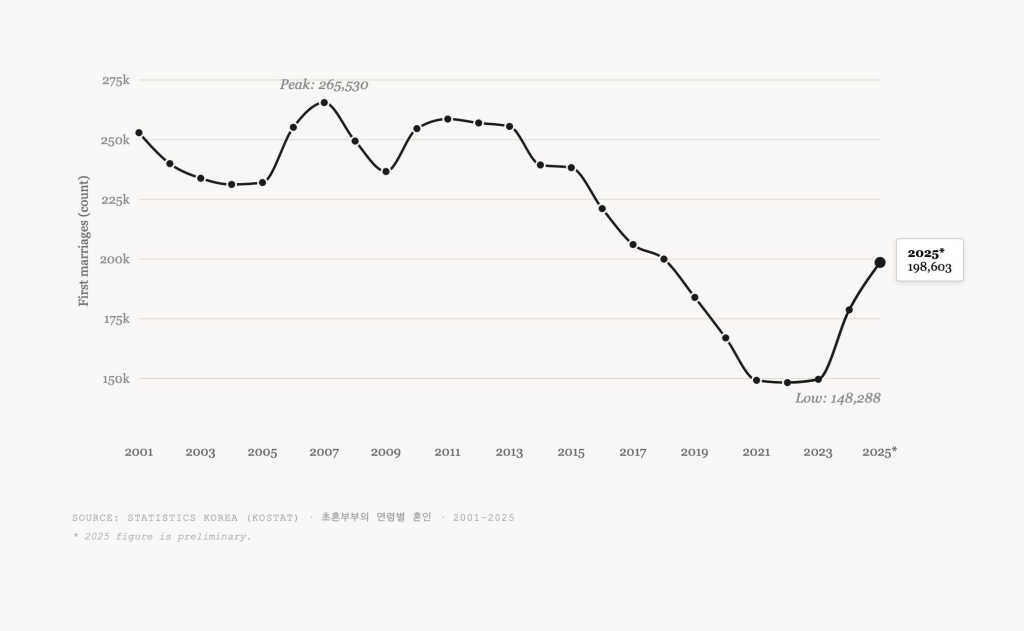
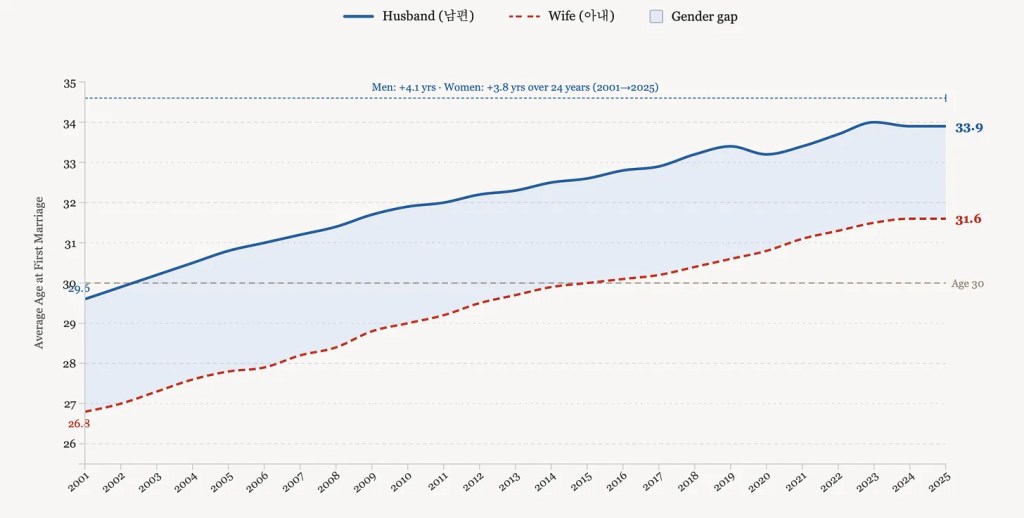
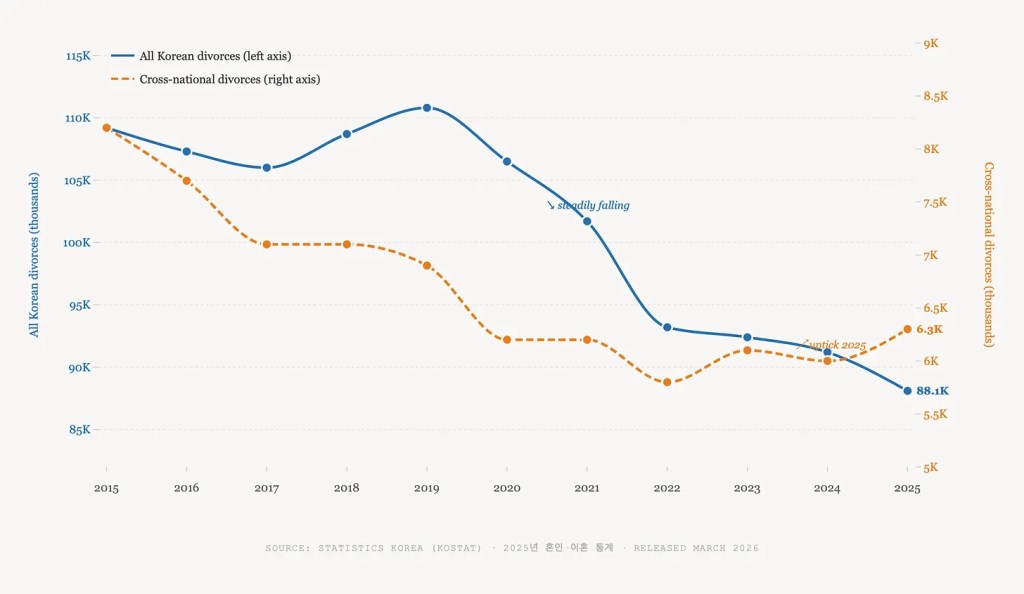
And it gets better. It could be the money the government is offering to marry and stay married, but the number of divorces are dropping too.
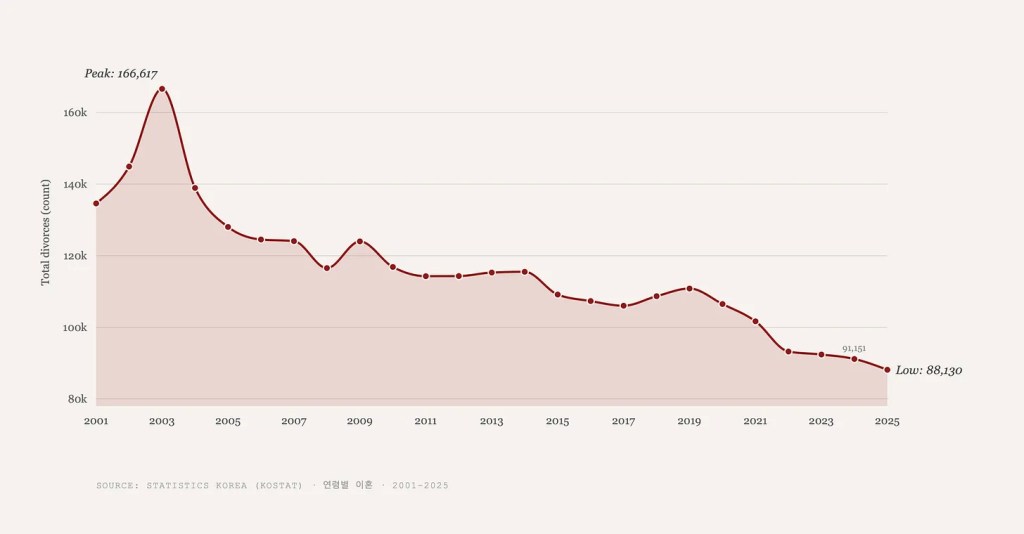
Who’s divorcing whom? How long are they staying together before they divorce? When are they divorcing? I have answers, but there are some caveats to the data below.
1. Anyone who’s been in a marriage has lived through subtle frictions that are part of it. These frictions don’t manifest into a divorce overnight. These problems however, if left unaddressed, can fester for months or even years before one bitter morning you verbalize that nagging feeling you’ve had for a while. “Shall we divorce?”. Therefore to treat the timestamp of a divorce as the timestamp of a breakdown would be to confuse the verdict with the trial, and any conclusions drawn from that assumption would be built on a fundamental misread of the data.
2. The data is an approximation because some of the data are based on age groups rather than an individual’s marriage or divorce.
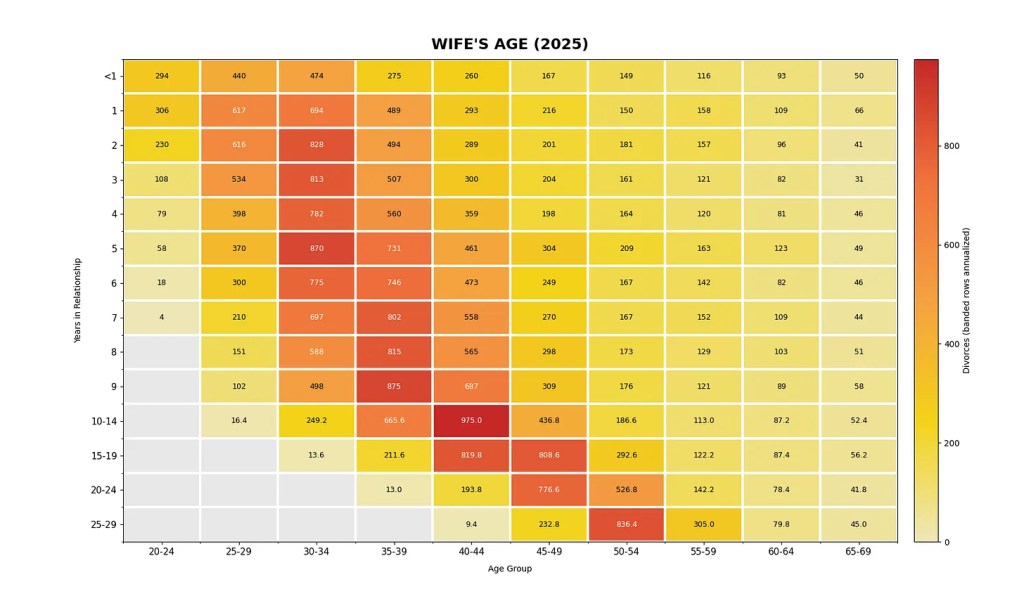
Having said that, here is the chart for the age of women who divorced in 2025, the number of years they were in a relationship for, before they divorced and the total number of divorces in each category.
**Note: the Fractions in the age groups are due to normalization.
And below is the chart for the age of men who divorced in 2025 along with the number of years they were in a relationshipbefore they divorced and the number of divorces.
**Note: the Fractions in the age groups are due to normalization
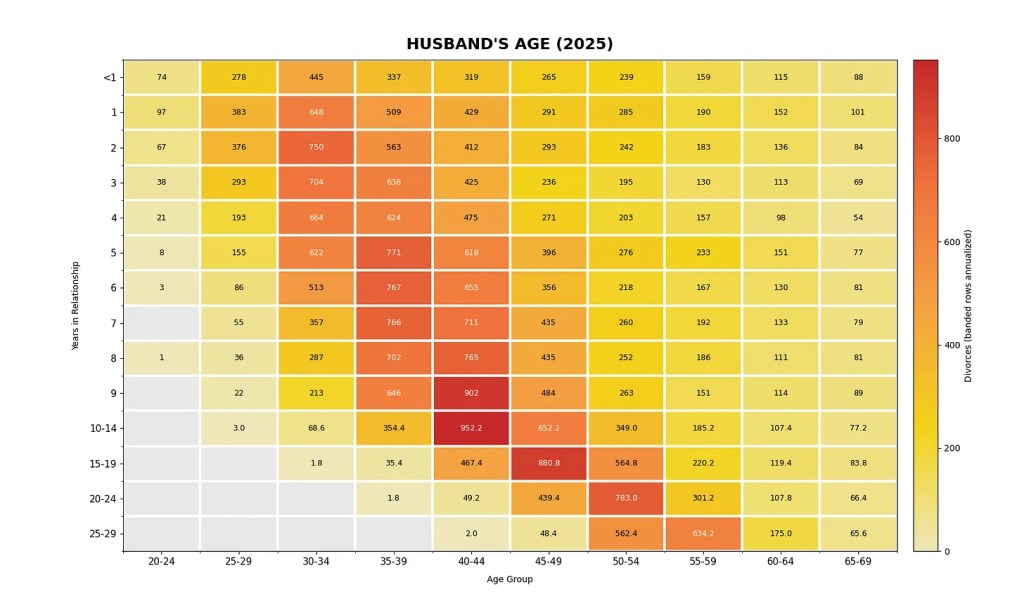
Unsurprisingly, the peak in divorces for both men and women are after a decade or so together. Most of the divorces happen after a couple have been together for a decade or so. 자녀를 위해. Staying Together for the Children. Most of these are when the couple wait till the children reach adulthood and decide there’s no reason to continue the charade anymore when it’s pretty obvious to everyone including the plant in the corner – the only thing that hasn’t dried out – that it’s time to part ways. Dig a little deeper, and this window will most likely also line up with a spike in pet ownership.
While it does appear that most of the divorces happens in the 30-39 age group, when looking at the total number of marriages in 2025,
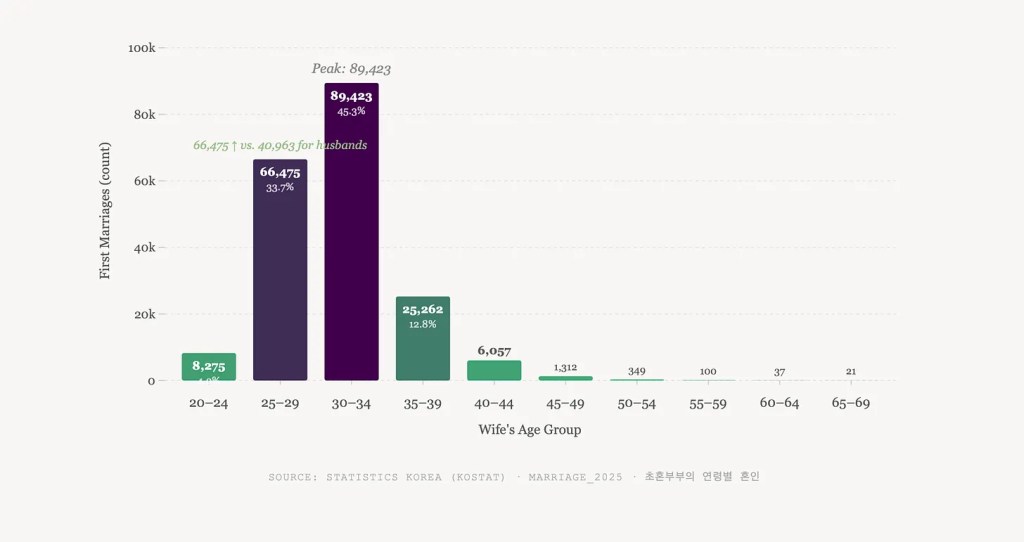
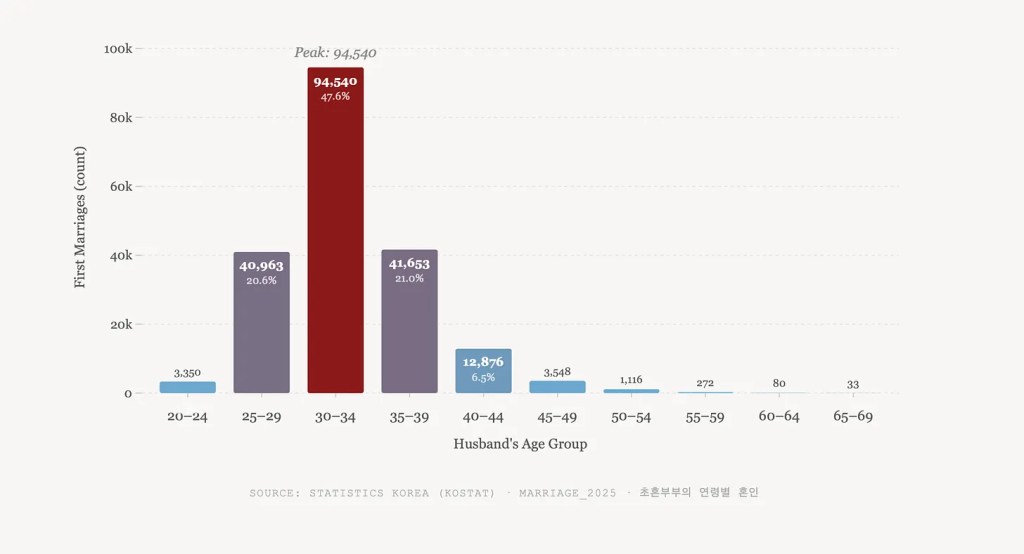
it confirms the need for a number of divorces/ marriages chart.
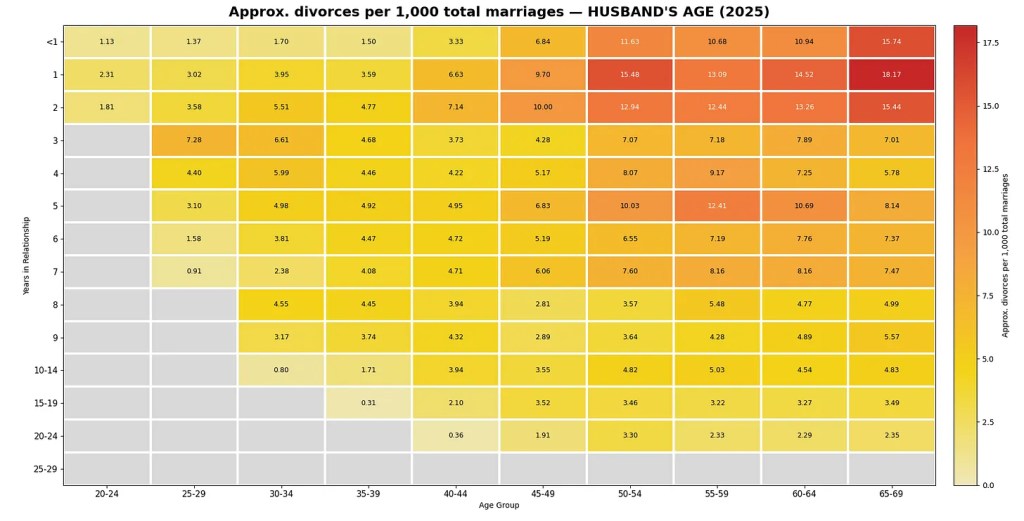
While there’s plenty to deduce from either heat map, my 3 main take aways from using the chart with the wife’s age as a reference,
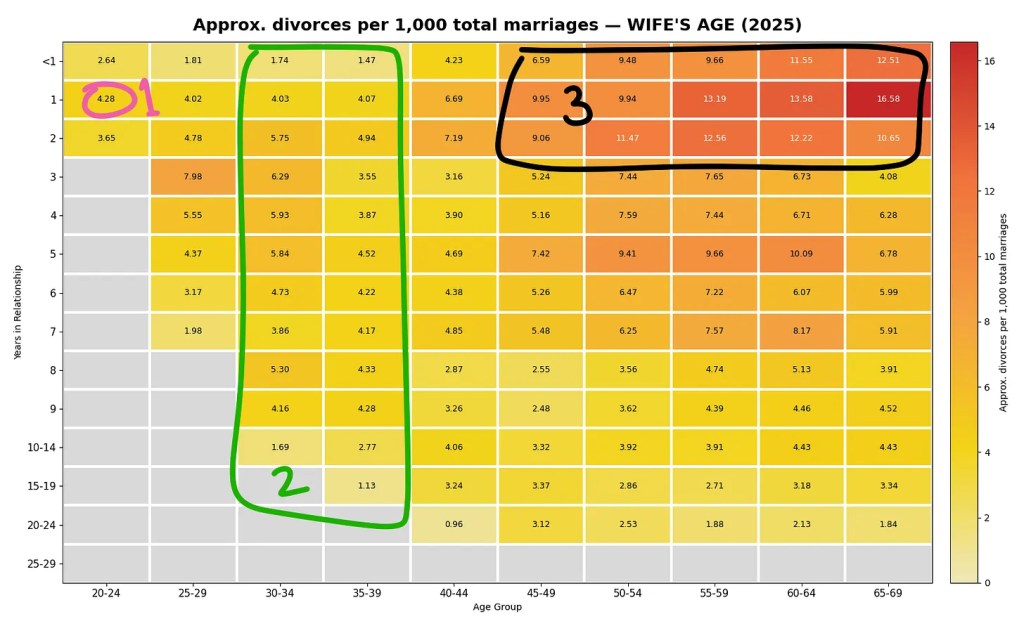
- The part of your brain responsible for attention, emotions, self-control and decision-making, the Pre-frontal cortex isn’t fully developed till you’re 25. So it is perhaps not surprising to see that little spike. 19-24 year old girls are divorcing after a year or two realizing they’ve made a mistake.
- The least number of divorces occur among 30-39 year olds. Most marry around this age. Most have kids around this age too. Between the young kids who are still adorable, a demanding job as you work hard to climb the corporate ladder, and the increasingly rare date nights with your partner, this period is the time when whatever resentment you may hold towards your partner starts building, but doesn’t quite surface yet. Life continues on autopilot.
- As people get older, if they find they are incompatible, with no burden of children weighing on their minds, it’s a swift adios. No one’s got the time nor the patience to stick around and find out if an indifferent partner is capable of change. It’s better for one’s own sanity to get an Ajjuma perm and a pet than to stay with a slobbering drunk.
The reasons. So why do couples divorce?
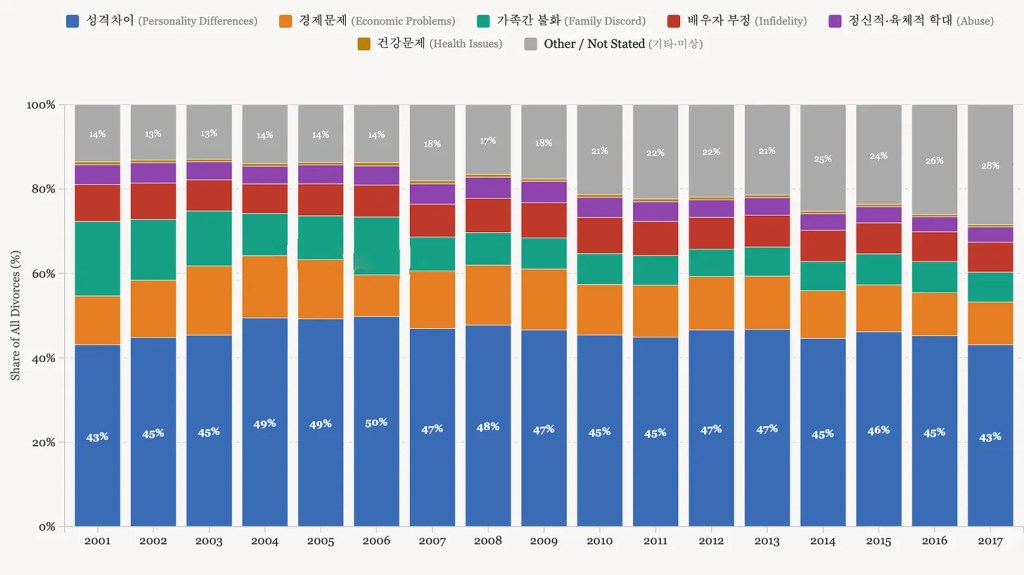
Personality differences account for most divorces, but that figure is likely inflated. Many likely put down “Personality differences” as a socially acceptable default: a catch-all that couples reach for when they want to avoid disclosing something more personal. Perhaps, an affair, financial failure, or maybe even abuse. But why admit to all this on an official government form. Why confess what you are not required to confess? Infidelity, abuse and economic problems almost certainly occur far more often than the data suggests; they simply get buried under vaguer categories.
This erosion of meaningful data is confirmed by the steady rise of “other/not stated,” which nearly doubled from 14% to 28% over the period. Combined with privacy concerns, the Korean government eventually stopped collecting divorce reasons altogether after 2017.
As a foreigner myself who is married to a Korean woman, I am interested to know what’s the data like if a Korean marries a foreigner instead. Is that a safer bet?
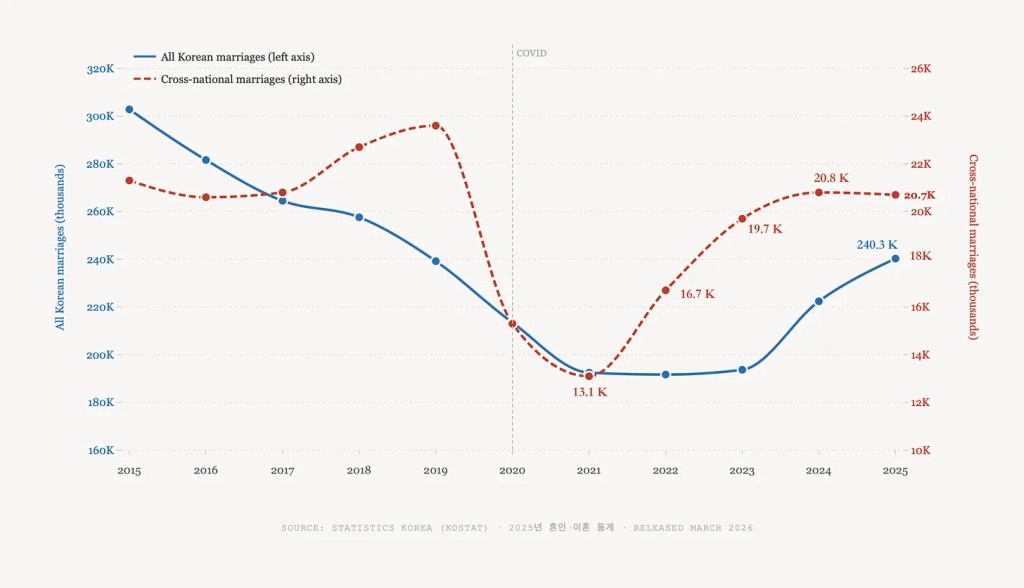
Post COVID, there was an uptick in the number of Koreans marrying foreigners, but it is beginning to plateau, in fact there’s been a drop in 2025 (20.7k) from the previous year (20.8k). However, the number of divorces between foreigners and Koreans is increasing.
Before we do a gender by gender breakdown, what are the nationalities of foreigners Koreans are marrying?
Sociologists have long noted that women tend to marry partners with equal or greater social standing and the data here reflects that pattern. Korean women predominantly marry men from developed countries.
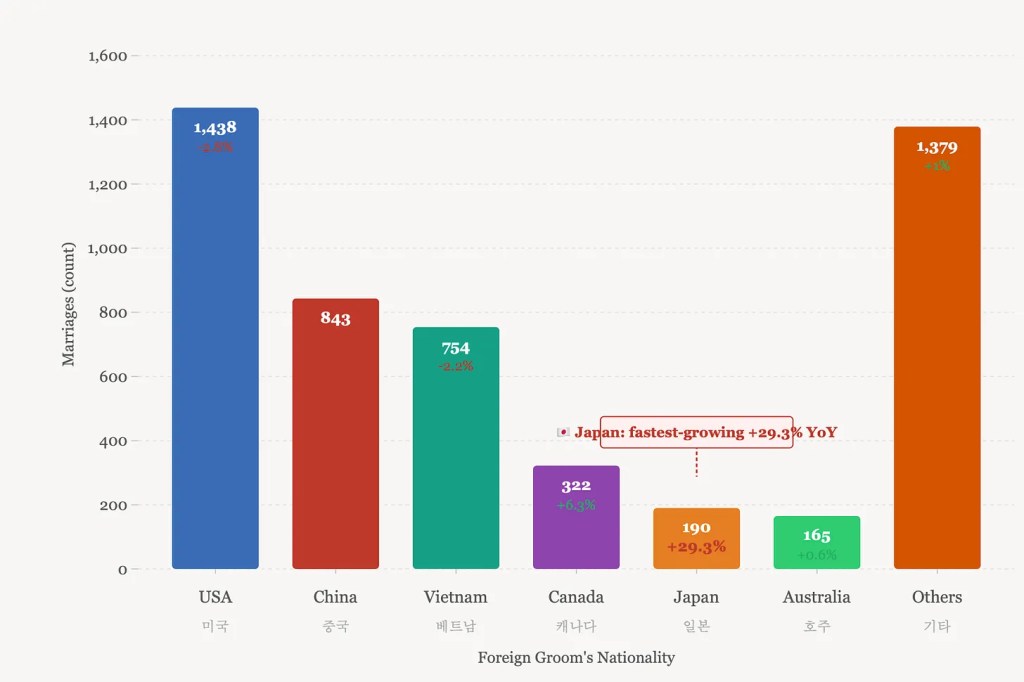
whereas for Korean men, the pattern splits between mail-order brides and partners from other developed nations.
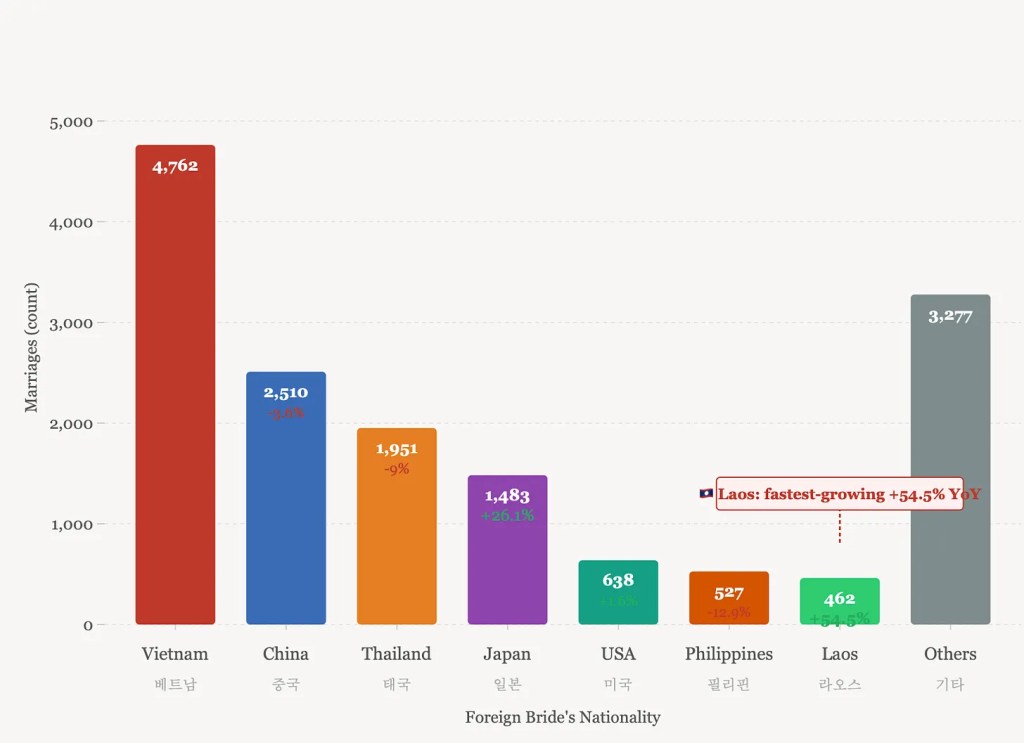
Now that we know who’s married whom, what are the divorce stats like for each gender?
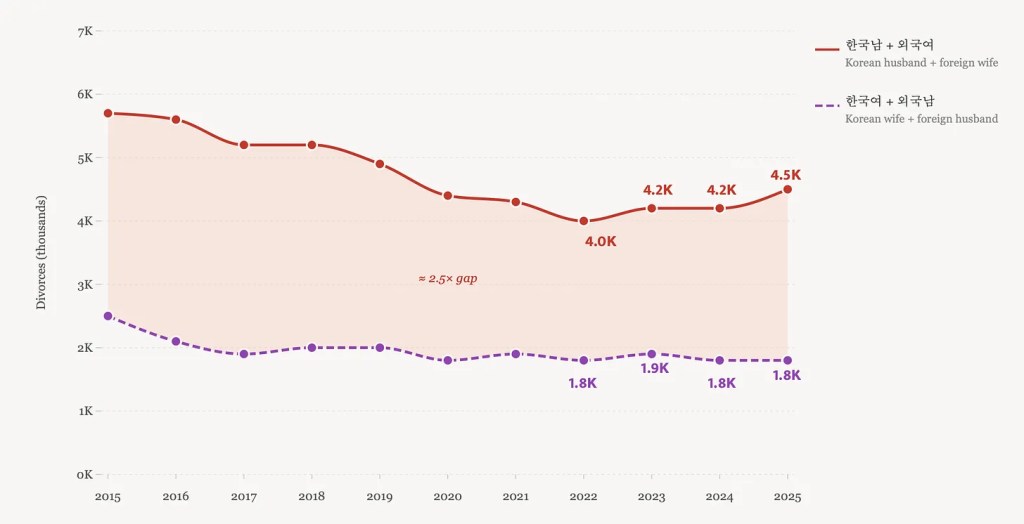
While the number of divorces between a Korean wife and a foreign husband remain more or less the same for years, there’s an increase in the number of divorces between a Korean husband and foreign wife.
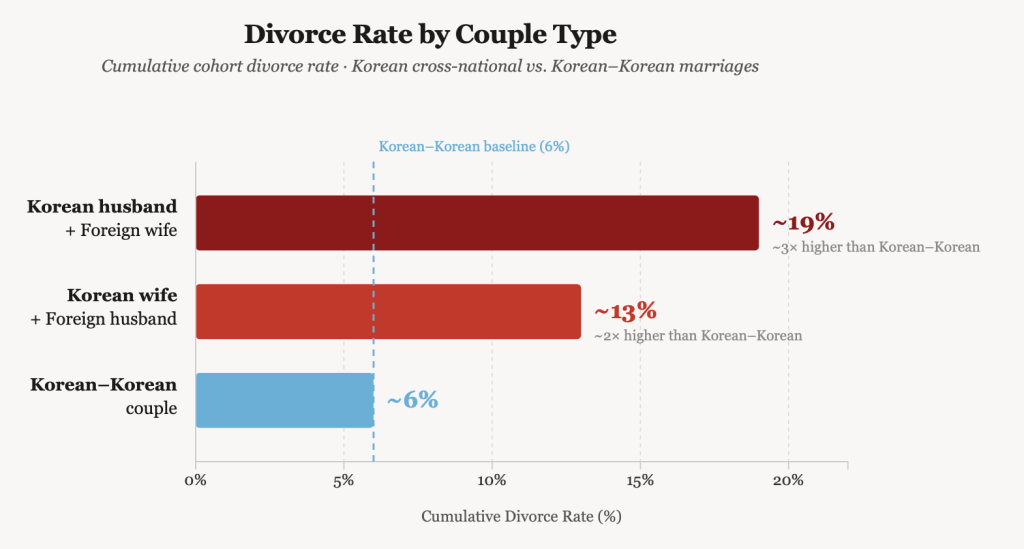
Data shows that Korean husbands with a foreign wife divorce at roughly three times the rate of Korean–Korean couples, while Korean wives with a foreign husband divorce at about twice the rate. By the numbers alone, the safest bet appears to be a Korean marrying a Korean. But if you do feel the butterflies in your stomach when you see him or her, then perhaps the more relevant question is not what the divorce rate is, but whether you are both willing to do the harder work that cross-cultural marriages genuinely demand: the language, the in-laws, the unspoken expectations carried across borders. The data captures what went wrong for others. It says nothing about what you are capable of getting right.
 AVILLAGEOFBIGHEADS
Leave a comment