Korea: South Korea’s soft power on the global stage is on the rise. From an obscure nation that was seen as America’s pet project in its fight against communism, it has risen to become the face of boy/girl bands. Even though South Korea’s appliances, vehicles, and smartphones bring in more revenue, it’s Korea’s cultural exports that have catapulted it into worldwide prominence. This exposure has brought along with it more foreigners who are moving to Korea. Some for economic reasons, some educational, some cultural and quite a few for Love.
Capitalistic Love: While women with flawless glass skin & courteous, suave men in inch-perfect Korean dramas are reasons enough to tempt many to move to Korea these days in hopes of quenching a hunger deep within, the heyday of Koreans marrying foreigners was actually in 2005.
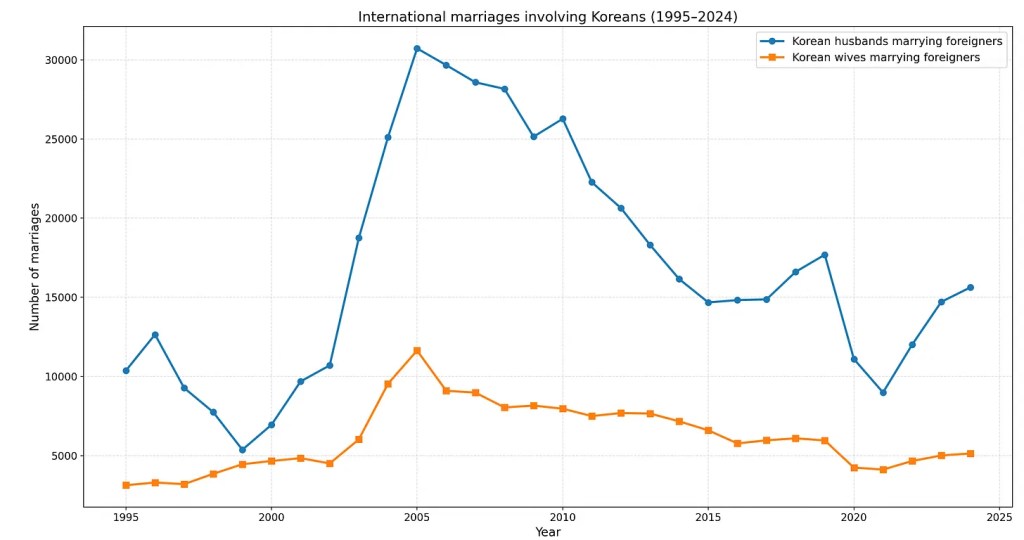
Rugged men with skin that resembled more a shattered glass pane, toiling out in sunshine in rural areas found it impossible to find a partner as women moved in droves to urban areas pursuing their dreams. The capitalistic solution to fill in the physical vacuum & emotional emptiness in rural Korea was found in economically backward regions of Vietnam, Thailand, Philippines and China.
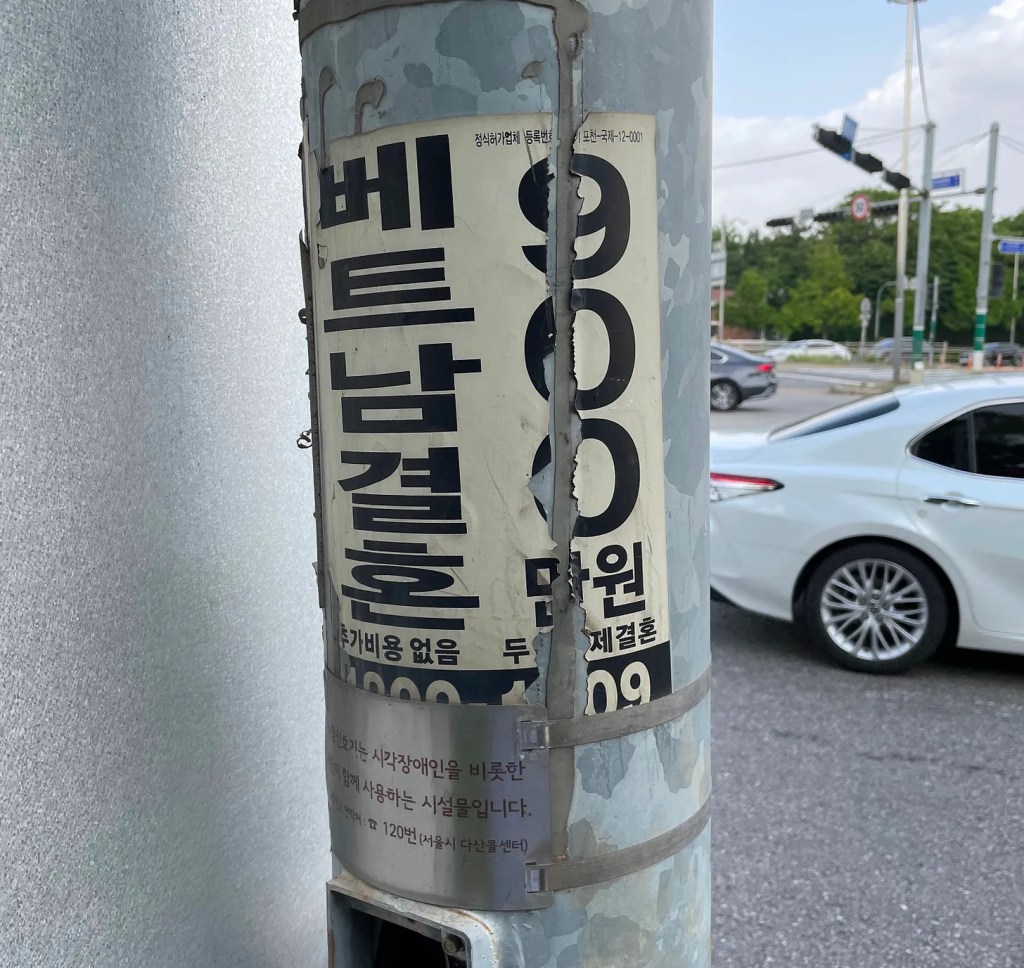
Prior to the 2007 Marriage Brokerage Regulation Act, unregulated marriage brokers popped up all over the place helping rural Koreans desperate for a partner find poverty stricken foreigners desperate for a better life.
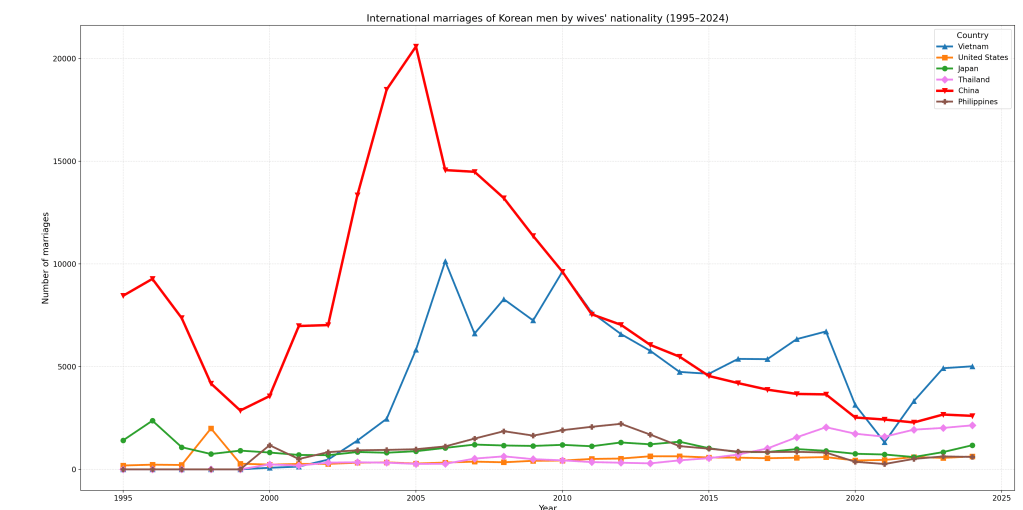
Oppas: Most of the Chinese who Koreans married were Korean-Chinese, also known as Joseonjok (조선족). They were seen as the easier option since most spoke fluent Korean and were already eligible for a Korean F4 visa due to their Korean heritage. Post 2010, as China’s economy surged, the need for a Korean Oppa to save them from poverty diminished.
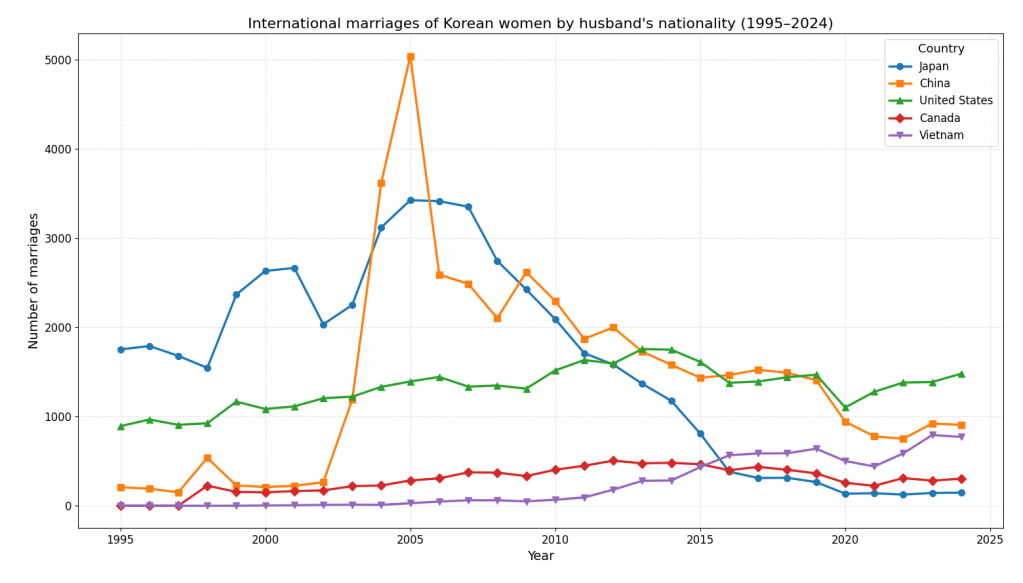
Noonas: In contrast, Korean women married either foreigners with Korean ethnicity, Chinese Koreans, Japanese Koreans (Zainichi Koreans, 재일동포) or those from wealthier nations such as USA and Canada. Interestingly, post 2010, there’s been an uptick in the number of Korean women marrying Vietnamese men. Any particular reason? It’s the big D.
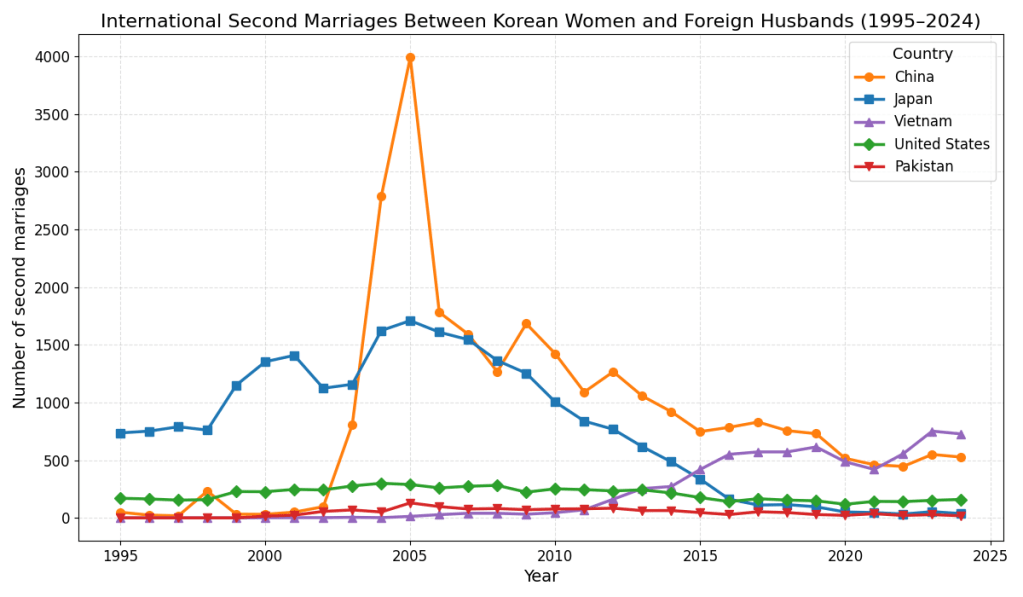
Divorcees: Divorced Korean women. Korean women who marry Vietnamese men are overwhelmingly divorced, at a ratio of 15:1 in comparison to first timers. If you can’t get someone local to marry you a second time, why not go fishing abroad touting the plentiful waters of Korea. The surprise, however, in the chart is Pakistan men marrying divorced Korean women at a ratio 1.65: 1, which is still considerably lower than Vietnam. All for Love. Love knows no boundaries, no pigmentation, no tainted history, just the occasional economic incentive. And everyone lived happily ever after.
Except this ain’t Sleepless in Seoul.
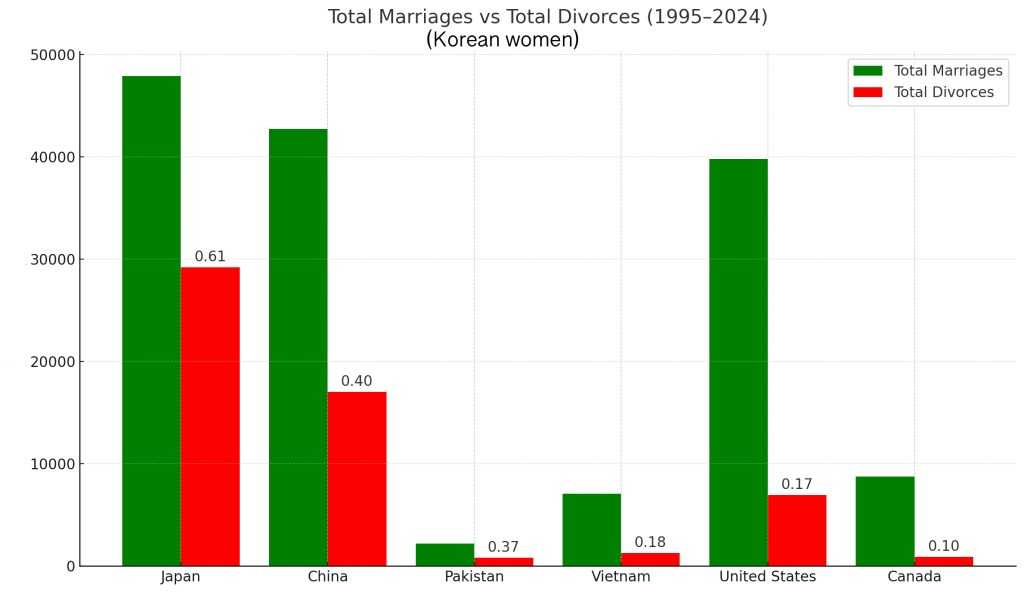
The three countries with the highest divorce rates are Japan, China & Pakistan. Any casual observer could come up with reasons as to why Pakistanis and Koreans might not make for an ideal relationship. Pakistan is an Islamic country, whereas Koreans are mostly agnostic or Christians. Korea is a traditional society much like Pakistan is, but traditions and customs are vastly different. While both are patriarchal societies, the Global Gender Gap Index 2024 rankings places South Korea at 94 and Pakistan at 145 just ahead of Sudan at the very last. Then of course, there is the in-your-face obvious difference in languages spoken. But the two countries ahead of Pakistan, China and Japan are proof that speaking the same language does not guarantee a happy marriage.
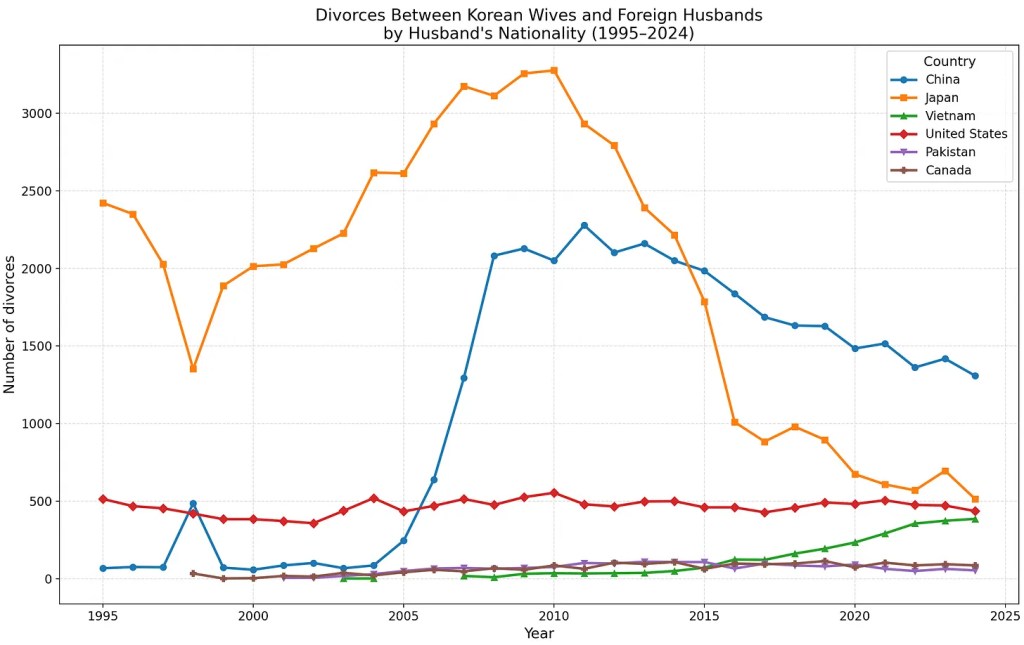
The peak in divorces are after a 5~6 year period since the peak in marriage for both Japan and China. The reasons for this unusually high divorce rates (61% for Japan and 40% for China) may be less obvious, but arranged marriages through un-regulated brokers looking to maximize profits never indicate a well thought out matrimony.
Do Korean men fare better when it comes to happily ever after?
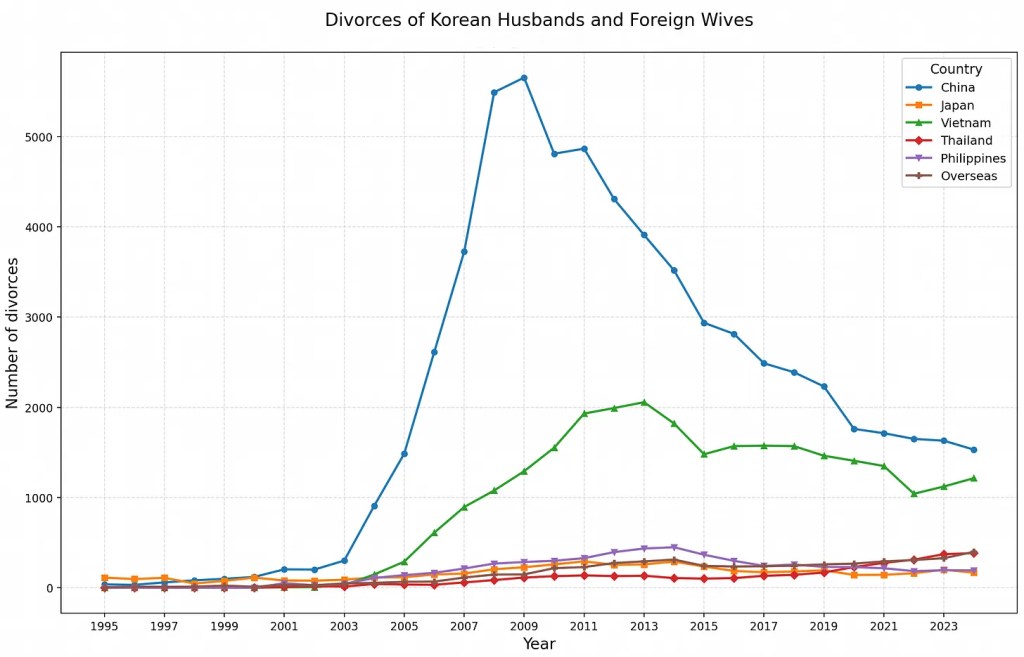
While it’s no surprise to see that most of the divorces are between Chinese and Koreans given the high number of marriages, the peak in divorces in 2009 indicate a short shelf life of 4 years of marriage
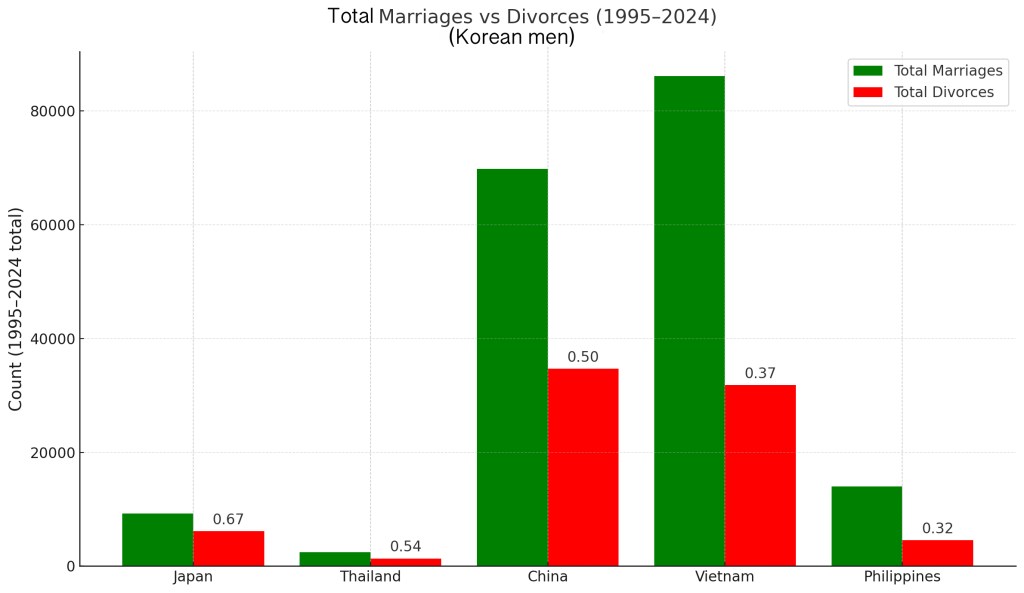
The one specific reason given for the high divorce rates with Japanese wives and Korean husbands are that Japanese women are far more financially independent. And given that most have F4 visa due to their Korean heritage, there is less need for one to be tied down if the romance fades. As for Thailand, I’d attribute the high divorce rate to most marriages being migrant marriages where one is looking to migrate for better economic opportunities rather than for love, a conclusion reinforced by broader migration data showing that Thai nationals have represented the largest share of visa overstays in Korea since 2016.
Well, if most marriages are those driven by economic necessities, are there any stats that point to those driven by K-dramas and K-pop?
F6. While there is no explicit statistic quantifying Koreaboos, the F6 marriage visa is one that comes closest. A F6 visa is for someone who’s married to a Korean. Not all with a F6 visa are someone who married specifically desiring a Korean due to their obsession with K-culture. But those that did are within that data set.
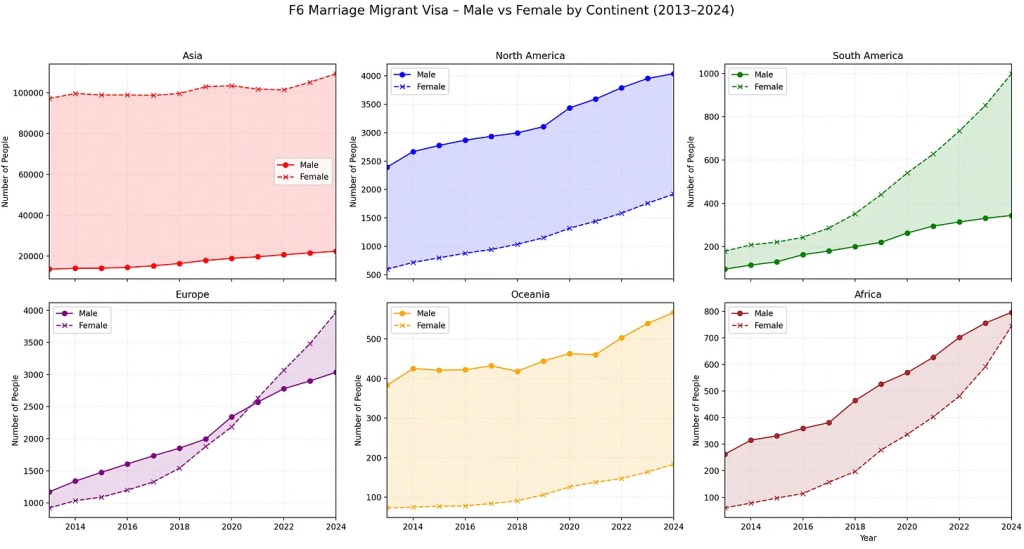
The interest in K-content has risen globally. In Mexico, there was an increase of 25% of on-demand audio and video streams of K-pop in 2023. Likewise, in Europe, there’s a growing demand for K-content. The pattern of increased interest is apparent in Argentina too. This increase translates into more enamored foreigners moving to Korea. More relationships. More marriages. What’s fascinating to note though from the graph above is the sharp increase of foreign women from Europe, South America and Africa marrying Korean men. Step aside Passport Bros. It’s the age of Oppa Hunters. They are here. They are coming.
 AVILLAGEOFBIGHEADS
Leave a comment